Brian
This post is long overdue, especially after Sam's posts on the posters of Mr. Bashar al-Assad around Syria. After attempting to cut corners and rent a cheaper car, our first rental car had air conditioning that didn't work, a dysfunctional radio, and a transmission that barely pulled us up the mountain from Aleppo to Latakia -- not to mention the six times we had to stop to have flat tires repaired. Our replacement rental car was delivered to us while we were visiting Saladin's Castle. Although we had to stop several times to have flats fixed with this car, and although after our trip to the Syrian Desert to visit Palmyra, the car refused to idle [a challenge in Damascus traffic!], it did have a functioning CD player.
This gem was found in that beautiful CD player. The CD was titled "Minhibak," we love you, in Syrian dialect. The last track of the CD was in English, and I'll allow you to imagine a group of four Americans (and Keegan's dad) driving around Syria blasting this music out the window, singing along. Sam, there's no question Bashar has a sense of humor.
Audio File: Bashar, We Love You
More download options here.
Enjoy.
Showing posts with label Syria. Show all posts
Showing posts with label Syria. Show all posts
Monday, August 20, 2007


Friday, August 3, 2007
Pick a Border, Pick an Identity.
Marium
It was 4 AM when we got to the Syrian border. I was with Mike Mallah, his sister, cousin and his friend. Four Jordanians and a Pakistani.
American.
I exited Jordan with my American passport and nervously entered the Syrian border security with my American passport carefully tucked away in my wallet, with my green Pakistani passport in my hand.
"Pakistani?" the tall syrian asked.
"Yes."
It was a reunion. A happy one. Syrians love Pakistanis apparently. They especially love the ones that speak broken Arabic.
"How long for a visa?" I asked.
The Syrian smiled and waved his hand.
Five minutes.
I glanced over at my Jordanian friends who were still in line.
Could it be? Could I really enter Syria without letting them know that I also had a blue passport?
Five syrian soldiers crowded around the window. A thin glass window seperated me and a group of Syrians. I felt warm, welcome and if there had been no window, I would have even expected a hug.
Yalla Ya Pakistan, they exclaimed.
"Where is your exit stamp from Jordan?"
Oh no. My heart dropped. I smiled. Gingerly taking out my American passport, I handed it to the Syrian and said, "Here."
Silence.
He took my Pakistani passport and threw it at the window.
"You are American."
It wasn't a question.
No. I'm Pakistani. I'm not American. I dont live in America. My family lives in Pakistan. We might be going for Umrah (the smaller Hajj) in Ramadan to Saudi Arabia. I am Muslim. I am Pakistani.
"You are American."
"How long for a visa?" The American Pakistani asked.
"We dont know. Possibly 6 hours. 7 hours. 8. A day. Two days. Damascus has to give us clearance."
"How long for a visa?" the Pakistani had asked 5 minutes before.
"Five minutes."
I decided to wait for the visa. I watched as my American passport was put aside, forgotten and my Pakistani was given back to me.
I waited for 2 hours. I got up and went to the window that said "foreigners" and asked for my passport. I decided to go back to Amman. It wasn't worth it.
"Wait," the sympathetic Syrian said, "just wait a little while longer."
Im Pakistani, I told him. Im American, I told him. Im not shit, I told him.
Give me back my passport.
The cab driver who was driving me back to Amman asked me where I was from.
I am American, I replied.
Tomorrow I am going to Israel. I've been there before. Last year I was at the border for a very, very long time.
"You're Pakistani?" the Israelis asked.
"Im American," I said, "I'm not Pakistani."
I live in America. My family lives in America. I've come to see Jerusalem. I know very few Pakistanis. I dont live in Pakistan. I am American.
"How long will it take?" I asked the Israelis.
"We dont know. 6 hours, 7 hours, a day. We dont know."
But I'm American.
"You were born in a terrorist country." they replied.
Im American. Not Pakistani.
Im Pakistani. Not American.
In this world I can't be both.
Pick one.
Or just lie.
It was 4 AM when we got to the Syrian border. I was with Mike Mallah, his sister, cousin and his friend. Four Jordanians and a Pakistani.
American.
I exited Jordan with my American passport and nervously entered the Syrian border security with my American passport carefully tucked away in my wallet, with my green Pakistani passport in my hand.
"Pakistani?" the tall syrian asked.
"Yes."
It was a reunion. A happy one. Syrians love Pakistanis apparently. They especially love the ones that speak broken Arabic.
"How long for a visa?" I asked.
The Syrian smiled and waved his hand.
Five minutes.
I glanced over at my Jordanian friends who were still in line.
Could it be? Could I really enter Syria without letting them know that I also had a blue passport?
Five syrian soldiers crowded around the window. A thin glass window seperated me and a group of Syrians. I felt warm, welcome and if there had been no window, I would have even expected a hug.
Yalla Ya Pakistan, they exclaimed.
"Where is your exit stamp from Jordan?"
Oh no. My heart dropped. I smiled. Gingerly taking out my American passport, I handed it to the Syrian and said, "Here."
Silence.
He took my Pakistani passport and threw it at the window.
"You are American."
It wasn't a question.
No. I'm Pakistani. I'm not American. I dont live in America. My family lives in Pakistan. We might be going for Umrah (the smaller Hajj) in Ramadan to Saudi Arabia. I am Muslim. I am Pakistani.
"You are American."
"How long for a visa?" The American Pakistani asked.
"We dont know. Possibly 6 hours. 7 hours. 8. A day. Two days. Damascus has to give us clearance."
"How long for a visa?" the Pakistani had asked 5 minutes before.
"Five minutes."
I decided to wait for the visa. I watched as my American passport was put aside, forgotten and my Pakistani was given back to me.
I waited for 2 hours. I got up and went to the window that said "foreigners" and asked for my passport. I decided to go back to Amman. It wasn't worth it.
"Wait," the sympathetic Syrian said, "just wait a little while longer."
Im Pakistani, I told him. Im American, I told him. Im not shit, I told him.
Give me back my passport.
The cab driver who was driving me back to Amman asked me where I was from.
I am American, I replied.
Tomorrow I am going to Israel. I've been there before. Last year I was at the border for a very, very long time.
"You're Pakistani?" the Israelis asked.
"Im American," I said, "I'm not Pakistani."
I live in America. My family lives in America. I've come to see Jerusalem. I know very few Pakistanis. I dont live in Pakistan. I am American.
"How long will it take?" I asked the Israelis.
"We dont know. 6 hours, 7 hours, a day. We dont know."
But I'm American.
"You were born in a terrorist country." they replied.
Im American. Not Pakistani.
Im Pakistani. Not American.
In this world I can't be both.
Pick one.
Or just lie.
Thursday, August 2, 2007
(about more than football)
sam
I wrote earlier about Iraq's victory in the quarterfinals of the Asia Cup and since then the side's success has continued.
As a result, last Sunday sweat dripped down my nose and I looked forward to the oscillating fan's next turn to my side of the room in a packed Aleppo cafe. The championship grudge match between Iraq and Saudi was about to begin.
If the crowd's loyalties were ever in doubt, the first few runs up the pitch removed it. A man in the front row uttered a guttural "helwa," literally meaning sweet, every time the Iraqis made an auspicious move. The rest of the cafe followed his lead, exhorting the Iraqis to pass the ball more precisely, run faster, and reach out their arms farther. The instructions provided to the Saudis mostly contained a message of, as Woody Allen once said, "'be fruitful and multiply' but not in those words."
There was a certain electricity in the room, even when the actual electricity briefly went out during the second half. Young men sat arm-in-arm on the edge of their seats and a constant stream of passerby poked their head in the door for score updates, which for a while consisted of "siphr, siphr," 0-0. At least until the Iraqis broke the gridlock in the second half with a header by Younes Mahmoud. Even "helwa" man in the front row was inaudible amidst the roar that marked the score. Traffic in the streets literally stopped.
The final minutes were tense, with the Saudis managing a few stoppage time attempts on goal.
I wrote earlier about Iraq's victory in the quarterfinals of the Asia Cup and since then the side's success has continued.
As a result, last Sunday sweat dripped down my nose and I looked forward to the oscillating fan's next turn to my side of the room in a packed Aleppo cafe. The championship grudge match between Iraq and Saudi was about to begin.
If the crowd's loyalties were ever in doubt, the first few runs up the pitch removed it. A man in the front row uttered a guttural "helwa," literally meaning sweet, every time the Iraqis made an auspicious move. The rest of the cafe followed his lead, exhorting the Iraqis to pass the ball more precisely, run faster, and reach out their arms farther. The instructions provided to the Saudis mostly contained a message of, as Woody Allen once said, "'be fruitful and multiply' but not in those words."
There was a certain electricity in the room, even when the actual electricity briefly went out during the second half. Young men sat arm-in-arm on the edge of their seats and a constant stream of passerby poked their head in the door for score updates, which for a while consisted of "siphr, siphr," 0-0. At least until the Iraqis broke the gridlock in the second half with a header by Younes Mahmoud. Even "helwa" man in the front row was inaudible amidst the roar that marked the score. Traffic in the streets literally stopped.
The final minutes were tense, with the Saudis managing a few stoppage time attempts on goal.
 But as the final whistle sounded, the celebration was on.
 Honking cab drivers conceded the road to revelers as they marched to Aleppo's main square, waving the Iraqi flag and shouting for joy.
 In the marble square Syrians and Iraqi refugees alike continued the celebration, which occurred, naturally, under the watchful eye of Bashar Al-Assad and other Syrian nationalist imagery.
(Bashar is always watching, this time from a lamp post)
Finally the crowd of merrymakers, ringed by a greater crowd of merrymaker-documenters armed with cell phones and cameras, gathered underneath a martyrs statue of some sort. Chants ensued as did political rhetoric, reminding us of the intricate connection between the ritual of sport and the political undercurrents of everyday life.
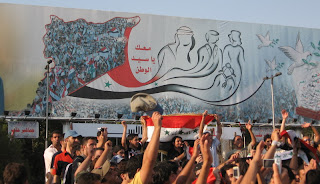
(Iraqi flag wavers beneath a billboard featuring the Syrian borders outlining a collage of Syrian flag wavers)
Proving, I suppose, that all politics are local, the first speeches praised Bashar (I wonder if Bashar had hired these guys to do it -- or maybe it was just his affinity for conservative suits and neckties that generated the outpouring of support). Israel and Hassan Nasrallah quickly followed. Finally they mentioned Iraq, this time in an iteration of "bidam, birooh, nifdayak ya iraq" with blood, with spirit, we will redeem you Iraq and only after that did America come up. At this point conspicuous American with camera and disgustingly sweat stained shirt made his way to the edge of the celebration.
 But that didn't keep me from thinking about the larger implications of the day's events. Among them, how many people would die in Baghdad as a result of the team's success. Bombers had targeted the large celebrations after the team's victory in the semifinals and celebratory gunfire took even more lives. Sunday's victory didn't prove to be an exception.
More broadly, I think we are seeing Iraq becoming similar to Palestine as a lightning rod issue sure to elicit sympathy beyond the bounds of the narrow nation-state identity. Though Arab nationalism might be dying, breath still remains, symbolized by the black, green, and red of pan-Arabism still present in most flags. Even in Amman, where the Saudis have traditionally held a monopoly on street celebrations (I spoke with an Iraqi about this and he joked that since they don't work, waving the Saudi flag out the window of German luxury cars while rhythmically honking is all they can do to pass the time), Iraqis filled the streets.
The question for me is whether support of Iraq represents an act of personal-identity projection. That is, what does waving the Iraqi flag mean for a Syrian or a Jordanian? Does she or he view it as an act of solidarity with an embattled nation? An act of resistance against an occupying hegemon? Requiem for a powerful Sunni Arab state? How does this differ for an Iraqi Sunni or Shi'i? These acts of national imagination all rely on particular personal resonance.
Much is made of the unifying power of the football team's run to the championship. The archetypal image of this has been the fluttering Iraqi flag, symbolizing the unity of Kurds, Chaldeans, Turkomen, Sunni, and Shi'a. But if waving the flag represents something completely different for different groups, does the notion of a unified state hold?
I don't know. I suppose it is inevitable that different groups will understand ideas and the symbols that represent them in different ways.
But the most important point here is security, again underscored by the vehicle bans put in place in the capital before the final as well as the Captain Younes Mahmoud's concerns about security in Baghdad.
Away from the solidarity expressed by the regional celebrations, it seems the Asia Cup has provided Iraqis with a brief, if joyous, distraction from everyday life. But the point is that the currents and themes displayed within these celebrations - regional support of the Iraqi "idea," the prevalence of identity in expressions of national belonging - will remain absolutely essential components of the political and the human aspects of life in Iraq and within the region.
Monday, July 16, 2007
منحبك يا بشار
sam
Last Friday, I made something of an impulsive decision to go to Damascus. You can do it quite easily here, as it's only 3 hours away. I woke up early and after brief negotiations with a white-bearded driver, I was on my way to the Sham, as they say, in an aging piece of Detroit muscle (Japanese cars just aren't strong enough, my driver explained).
 When I explained my obsession to the Syrians with whom I shared the car, they laughed, both because they thought that I was another mildly insane American (not to be confused with Dr. Evil-ish insane Brits) and because they knew that if I were excited by such a small example of nationalist shirk, I might briefly lose consciousness given the persistence of Bashar's face throughout Damascus.
Indeed, Bashar seemed to follow me everywhere in Damascus, a constant reminder of significant differences between the Jordanian and Syrian political climate.
 For example, at this fast food stand, in addition to high cholestorol you get a taste of resistance. From left, Iranian president Mahmoud Ahmadinejad (who, by the way, has an occasionally updated blog), Syrian president al-Assad, and Hezbollah leader Hassan Nasrallah. It is interesting to note that though you might find some pictures of Ahmadinejad or Nasrallah if you looked very hard in Amman, you will never ever ever see King Abdullah in the same picture. Before we see Ahmadinejad and Abdullah smiling arm and arm above the local falafel stand, I'd expect a subpar major league baseball owner to become president of the United States - no, that happened. Ah, here it is - I would expect to see Abdullah renounce his love for Star Trek before I'd expect to see him sharing a picture with Nasrallah.
And this isn't just about using every possible opportunity to publicize Abdullah's love for Star Trek. It's reflective of the larger regional political dynamics, part of what Vali Nasr calls the Shia Revival, what King Abdullah himself called the Shia Crescent, the emerging Shia power bloc extending through Iran, Iraq, Syria, and Lebanon.
The religious appellation is perhaps misleading. As an outspoken Arab many of us know and love pointed out to me, the placement of Ahmadinejad and Nasrallah (both Shia) with Bashar al-Assad (who is Alawite, a Shia minority group) is more a political phenomenon than a religious one. Though their faiths correspond, it is more about placing Bashar al-Assad on the "resisting Western hegemony and aggression" plane than anything else. The long standing secularism of Bashar's Ba'ath party - founded by a Christian and a Sunni Muslim in Damascus - further underscores this point.
Nevertheless, as the respective resistance of Western hegemony has increased the popularity of men like Nasrallah and Ahmadinejad in the region, the separation has corresponded to religious fault lines, worrying secular Sunni autocrats like Jordan's King Abdullah, like Egypt's Hosni Mubarak. Witness their initial reluctance to condemn the hostilities in the Lebanon War last summer, witness American acquiescence over Egyptian efforts to develop nuclear technology.
Indeed, the icons on this fast food stall reveal a widening philosophical gap among regional leaders. To collaborate with Western governments (while being careful to avoid alienating the populace) or resist them (at least rhetorically)?
And, more importantly, behind the rhetoric, behind the summits, behind the furious editorials, what of the people? If the election posters told the whole story, Syrians are pretty content.
This poster says "N'am," yes. Actually, it says "n'am, n'am, n'am...." You get the point. All in the form of the Syrian flag. Though if it were to be completely accurate to the Syrian elections it would include two or three no's in there.
 All those yeses, however, surely can't compete with the poster below, which reads "Thalath fee qaloobna: Allah, Soorea, wa Al-Assad," Three in our hearts: God, Syria, and Al-Assad.
 And here, perhaps, is the greatest honor Al-Assad can achieve. Again, we see old friend Nasrallah and Daddy Hafez to the right, but this time Egyptian pop sensation Tamer Hosny and international icon David Beckham join him on the left. Given the success of Mr. Hosny's latest single and his recently released film, I think Mr. Al-Assad is the lucky one here.
 Despite these apparent displays of affection, I'm not going to lie, I'm a little disappointed with Bashar. Granted, not everyone can have the dress-up wardrobe of King Abdullah, but give me some personality, ya Bashar! All I can gather from most of these is that you like double windsor knots, conservative suits, and stern expressions. At least Nasrallah smiles!
 To be fair, he has a tough act to follow. His father, who ruled Syrian from 1970 to 2000 still finds ways to remind Syrians of his rule. Isn't this everyone's dream valentine?
 But Bashar does find ways to innovate. In the image below, we see Bashar going post-modern on us. The image of Bashar is superimposed on an image that contains posters of Bashar within it. Very mimetic. Interestingly, the background image - of Damascus University - features a Syrian flag next to a Palestinian flag, a flourish of symbolism that you would never see in Amman. After all, since Palestinians constitute a much larger percentage of the populace in Jordan, they also constitute a larger threat to the creation of a single, inclusive national identity, making the co-opting of Palestinian symbols into the larger Jordanian narrative that much more necessary for the Hashemite regime.
 Below, we see Bashar's ray-banned silhouette on a car windshield in the Old City. It would be cool on its own, not the least because it looks very similar to a Borat shirt that I have. Nice. But what makes it ten times cooler is the Batman sign right above it. Seriously, check it out. Naturally, this raised some real possibilities in my head - can we get some sort of Bashar-signal working for when he's really needed, putting the image of Bashar into the night skies whenever justice is threatened, wherever foes need vanquishing, or, at least, when they run out of guava juice at the neighborhood smoothie stand? It could even be called the Baath signal.
 For all of this symbolism, pageantry, and nation creation, it is misleading to suggest that Syria is Bashar and Bashar is Syria (which the phrase above Bashar's silhouette - Syria of al-Assad - promotes). Most people I spoke with displayed the images not so much out of devotion as what seemed to be fatalism, resigned to the sometimes absurdist nature of life.
Indeed, the heritage of Damascus boasts a vibrancy and richness that predates the Assad family's rise to prominence. The Umayyad Mosque, where I spent an afternoon lazing about, was the centerpiece of the early 8th century caliphate, whose domain extended from Spain in the West to Afghanistan in the East.
 Indeed, for much of history, what is now Syria existed as part of entirely different socio-polities, with trade items from China and India passing through Roman and Greek administered centers of commerce. Borders, national identity, and Bashar al-Assad were entirely foreign concepts.
The boxes of identity that exist now - Muslim, Arab, Syrian, rogue state - either didn't exist or were a little more fluid back then. And they still are - at least more than we give them credit for. For example, the Umayyad Mosque contains a shrine with the head of John the Baptist, venerated in Christianity and Islam. The remains of the great warrior Saladin - who, as a Kurd, would probably be persecuted in Syria today - rest outside.
The evidence of these alternative forms of identity and existence are displayed extensively at the sprawling Syrian National Museum, alongside, well, more modern inventions.
 As I sat in an alcove inside, I gazed at a map of various archaeological sites and cities of antiquity. The modern borders of Syria, Lebanon, and Iraq had been superimposed. Sort of like the posters of Bashar are super-imposed onto the lives of regular people. And the absolute novelty of this idea of nation-states struck me.
Far away from these nationalist posters and maps, hospitality filled kitchens and friendly conversations underscored for me the reality of cultural flows and intersections, transcending the simplification and constructed-ness of national identities.
Any Jordanian will tell you that mansaf - a meal of meat, yogurt, and rice eaten with one's hands - is the Jordanian national dish. I even spoke with a virulent Jordanian nationalist at one point who claimed that it was one of the foundational elements of true Jordanian-ness. I couldn't help but laugh as I ate a very similar, very delicious dish in a Damascus apartment.
Even the trappings of nationalism that I so adore - which are often the basis for divisiveness - evince a certain degree of similarity. Several weeks ago I noted the picture of King Abdullah on the Ministry of Agriculture. In full military regalia, he dutifully waters a sapling.
 As I wandered around Damascus University at one point, I noticed an eerily similar image at the Syrian Ministry of Agriculture, featuring Bashar, hoe in hand, participating in the national agricultural effort. He's even got his sleeves rolled up.
 The Arabic reads "All of us are with you." And in this case, it rings true, not in the sense that we should all grab our farm implements. Moreso that for better or worse, we are all living in a world of nationalism, nation-states, and their inherent absurdities.
Last Friday, I made something of an impulsive decision to go to Damascus. You can do it quite easily here, as it's only 3 hours away. I woke up early and after brief negotiations with a white-bearded driver, I was on my way to the Sham, as they say, in an aging piece of Detroit muscle (Japanese cars just aren't strong enough, my driver explained).
For me, Damascus represented a respite from the newness of Amman, a trip to a city fabled due to its history, alluring due to its rather stringent visa requirements, and apparently dangerous given it's status as a John Bolton (who, unbeknownst to most of the world, received a shout out in Kanye West's Diamonds from Sierra Leone - I'll give you a hint: it rhymed with "international masshole") characterized rogue state (though right now it's probably the safest place one could go in the Middle East).
Plus, as the legions of loyal THT readers are well aware, I'm interested in public representations of autocratic leaders. In the wake of the recent election (more information available from Maryam here and from Joshua Landis here), ubiquitous posters of Bashar al-Assad provided numerous opportunities for visual analysis and poking fun. I was so enthralled with the possibilities (or perhaps just bored at the border) that I took this picture of Bashar al Assad and his father, Hafez.
Plus, as the legions of loyal THT readers are well aware, I'm interested in public representations of autocratic leaders. In the wake of the recent election (more information available from Maryam here and from Joshua Landis here), ubiquitous posters of Bashar al-Assad provided numerous opportunities for visual analysis and poking fun. I was so enthralled with the possibilities (or perhaps just bored at the border) that I took this picture of Bashar al Assad and his father, Hafez.
 When I explained my obsession to the Syrians with whom I shared the car, they laughed, both because they thought that I was another mildly insane American (not to be confused with Dr. Evil-ish insane Brits) and because they knew that if I were excited by such a small example of nationalist shirk, I might briefly lose consciousness given the persistence of Bashar's face throughout Damascus.
Indeed, Bashar seemed to follow me everywhere in Damascus, a constant reminder of significant differences between the Jordanian and Syrian political climate.
 For example, at this fast food stand, in addition to high cholestorol you get a taste of resistance. From left, Iranian president Mahmoud Ahmadinejad (who, by the way, has an occasionally updated blog), Syrian president al-Assad, and Hezbollah leader Hassan Nasrallah. It is interesting to note that though you might find some pictures of Ahmadinejad or Nasrallah if you looked very hard in Amman, you will never ever ever see King Abdullah in the same picture. Before we see Ahmadinejad and Abdullah smiling arm and arm above the local falafel stand, I'd expect a subpar major league baseball owner to become president of the United States - no, that happened. Ah, here it is - I would expect to see Abdullah renounce his love for Star Trek before I'd expect to see him sharing a picture with Nasrallah.
And this isn't just about using every possible opportunity to publicize Abdullah's love for Star Trek. It's reflective of the larger regional political dynamics, part of what Vali Nasr calls the Shia Revival, what King Abdullah himself called the Shia Crescent, the emerging Shia power bloc extending through Iran, Iraq, Syria, and Lebanon.
The religious appellation is perhaps misleading. As an outspoken Arab many of us know and love pointed out to me, the placement of Ahmadinejad and Nasrallah (both Shia) with Bashar al-Assad (who is Alawite, a Shia minority group) is more a political phenomenon than a religious one. Though their faiths correspond, it is more about placing Bashar al-Assad on the "resisting Western hegemony and aggression" plane than anything else. The long standing secularism of Bashar's Ba'ath party - founded by a Christian and a Sunni Muslim in Damascus - further underscores this point.
Nevertheless, as the respective resistance of Western hegemony has increased the popularity of men like Nasrallah and Ahmadinejad in the region, the separation has corresponded to religious fault lines, worrying secular Sunni autocrats like Jordan's King Abdullah, like Egypt's Hosni Mubarak. Witness their initial reluctance to condemn the hostilities in the Lebanon War last summer, witness American acquiescence over Egyptian efforts to develop nuclear technology.
Indeed, the icons on this fast food stall reveal a widening philosophical gap among regional leaders. To collaborate with Western governments (while being careful to avoid alienating the populace) or resist them (at least rhetorically)?
And, more importantly, behind the rhetoric, behind the summits, behind the furious editorials, what of the people? If the election posters told the whole story, Syrians are pretty content.
This poster says "N'am," yes. Actually, it says "n'am, n'am, n'am...." You get the point. All in the form of the Syrian flag. Though if it were to be completely accurate to the Syrian elections it would include two or three no's in there.
 All those yeses, however, surely can't compete with the poster below, which reads "Thalath fee qaloobna: Allah, Soorea, wa Al-Assad," Three in our hearts: God, Syria, and Al-Assad.
 And here, perhaps, is the greatest honor Al-Assad can achieve. Again, we see old friend Nasrallah and Daddy Hafez to the right, but this time Egyptian pop sensation Tamer Hosny and international icon David Beckham join him on the left. Given the success of Mr. Hosny's latest single and his recently released film, I think Mr. Al-Assad is the lucky one here.
 Despite these apparent displays of affection, I'm not going to lie, I'm a little disappointed with Bashar. Granted, not everyone can have the dress-up wardrobe of King Abdullah, but give me some personality, ya Bashar! All I can gather from most of these is that you like double windsor knots, conservative suits, and stern expressions. At least Nasrallah smiles!
 To be fair, he has a tough act to follow. His father, who ruled Syrian from 1970 to 2000 still finds ways to remind Syrians of his rule. Isn't this everyone's dream valentine?
 But Bashar does find ways to innovate. In the image below, we see Bashar going post-modern on us. The image of Bashar is superimposed on an image that contains posters of Bashar within it. Very mimetic. Interestingly, the background image - of Damascus University - features a Syrian flag next to a Palestinian flag, a flourish of symbolism that you would never see in Amman. After all, since Palestinians constitute a much larger percentage of the populace in Jordan, they also constitute a larger threat to the creation of a single, inclusive national identity, making the co-opting of Palestinian symbols into the larger Jordanian narrative that much more necessary for the Hashemite regime.
 Below, we see Bashar's ray-banned silhouette on a car windshield in the Old City. It would be cool on its own, not the least because it looks very similar to a Borat shirt that I have. Nice. But what makes it ten times cooler is the Batman sign right above it. Seriously, check it out. Naturally, this raised some real possibilities in my head - can we get some sort of Bashar-signal working for when he's really needed, putting the image of Bashar into the night skies whenever justice is threatened, wherever foes need vanquishing, or, at least, when they run out of guava juice at the neighborhood smoothie stand? It could even be called the Baath signal.
 For all of this symbolism, pageantry, and nation creation, it is misleading to suggest that Syria is Bashar and Bashar is Syria (which the phrase above Bashar's silhouette - Syria of al-Assad - promotes). Most people I spoke with displayed the images not so much out of devotion as what seemed to be fatalism, resigned to the sometimes absurdist nature of life.
Indeed, the heritage of Damascus boasts a vibrancy and richness that predates the Assad family's rise to prominence. The Umayyad Mosque, where I spent an afternoon lazing about, was the centerpiece of the early 8th century caliphate, whose domain extended from Spain in the West to Afghanistan in the East.
 Indeed, for much of history, what is now Syria existed as part of entirely different socio-polities, with trade items from China and India passing through Roman and Greek administered centers of commerce. Borders, national identity, and Bashar al-Assad were entirely foreign concepts.
The boxes of identity that exist now - Muslim, Arab, Syrian, rogue state - either didn't exist or were a little more fluid back then. And they still are - at least more than we give them credit for. For example, the Umayyad Mosque contains a shrine with the head of John the Baptist, venerated in Christianity and Islam. The remains of the great warrior Saladin - who, as a Kurd, would probably be persecuted in Syria today - rest outside.
The evidence of these alternative forms of identity and existence are displayed extensively at the sprawling Syrian National Museum, alongside, well, more modern inventions.
 As I sat in an alcove inside, I gazed at a map of various archaeological sites and cities of antiquity. The modern borders of Syria, Lebanon, and Iraq had been superimposed. Sort of like the posters of Bashar are super-imposed onto the lives of regular people. And the absolute novelty of this idea of nation-states struck me.
Far away from these nationalist posters and maps, hospitality filled kitchens and friendly conversations underscored for me the reality of cultural flows and intersections, transcending the simplification and constructed-ness of national identities.
Any Jordanian will tell you that mansaf - a meal of meat, yogurt, and rice eaten with one's hands - is the Jordanian national dish. I even spoke with a virulent Jordanian nationalist at one point who claimed that it was one of the foundational elements of true Jordanian-ness. I couldn't help but laugh as I ate a very similar, very delicious dish in a Damascus apartment.
Even the trappings of nationalism that I so adore - which are often the basis for divisiveness - evince a certain degree of similarity. Several weeks ago I noted the picture of King Abdullah on the Ministry of Agriculture. In full military regalia, he dutifully waters a sapling.
 As I wandered around Damascus University at one point, I noticed an eerily similar image at the Syrian Ministry of Agriculture, featuring Bashar, hoe in hand, participating in the national agricultural effort. He's even got his sleeves rolled up.
 The Arabic reads "All of us are with you." And in this case, it rings true, not in the sense that we should all grab our farm implements. Moreso that for better or worse, we are all living in a world of nationalism, nation-states, and their inherent absurdities.
Monday, July 2, 2007
this is your luck
maryam
In a list of the most commonly used statements in the Arabic language, this phrase would be in the top ten. The phrase’s frequent usage speaks so much about the personality of the society. I’ve never been one to believe the view of your life depending on your luck but in Arab culture it is more of an accepted fact than a belief.
Here so many events in one’s life are referred to as your luck. Marriage is commonly called “naseebak” or your luck. Your current job, status of living and even grades can be commonly referred to as your luck. It’s certainly not an atheistic point of view because your luck is from God.
I originally would be annoyed when anyone would use this phrase to refer to parts of his or her life because of the laziness that seemed to ooze from it. Accepting your luck seemed to be a lazy way of accepting circumstance and never fighting for something better.
I’ve grown a lot since those original thoughts.
I have a fighting spirit because I’ve seen things change purely from the hard work of everyday people. I know that I can work with the system to help others and myself. I know there is hope.
But what if you’ve never heard a good ending from a story dealing with the government? What if all your work is thrown back in your face by the system that was set up to protect you? How can you define citizenship if its definition exists in a world you’ve never seen? And what’s the point of marrying your true love if you end up losing your family, friends, home and all you own?
This is your luck not because you are too lazy to change it, but because it is happening to you. To you, your family, your country, your people. And there is no simple answer to why this is happening to us. Why the oppression, injustice, torture and despair? And why to me?
Because this is your luck
Humanity Rages like a tempest,
but i sigh in silence
for i know the storm must pass away
while a sigh goes to god.
-K. Gibran
A poet’s voice
In a list of the most commonly used statements in the Arabic language, this phrase would be in the top ten. The phrase’s frequent usage speaks so much about the personality of the society. I’ve never been one to believe the view of your life depending on your luck but in Arab culture it is more of an accepted fact than a belief.
Here so many events in one’s life are referred to as your luck. Marriage is commonly called “naseebak” or your luck. Your current job, status of living and even grades can be commonly referred to as your luck. It’s certainly not an atheistic point of view because your luck is from God.
I originally would be annoyed when anyone would use this phrase to refer to parts of his or her life because of the laziness that seemed to ooze from it. Accepting your luck seemed to be a lazy way of accepting circumstance and never fighting for something better.
I’ve grown a lot since those original thoughts.
I have a fighting spirit because I’ve seen things change purely from the hard work of everyday people. I know that I can work with the system to help others and myself. I know there is hope.
But what if you’ve never heard a good ending from a story dealing with the government? What if all your work is thrown back in your face by the system that was set up to protect you? How can you define citizenship if its definition exists in a world you’ve never seen? And what’s the point of marrying your true love if you end up losing your family, friends, home and all you own?
This is your luck not because you are too lazy to change it, but because it is happening to you. To you, your family, your country, your people. And there is no simple answer to why this is happening to us. Why the oppression, injustice, torture and despair? And why to me?
Because this is your luck
Humanity Rages like a tempest,
but i sigh in silence
for i know the storm must pass away
while a sigh goes to god.
-K. Gibran
A poet’s voice
Wednesday, June 27, 2007
a rose by any other name
maryam
For those who are lucky enough to have been to Syria know the feelings that cause me to declare, oh Damascus is Syria and Syria is Damascus. She is a city I have visited many occasions over the years. As I come back to her in the different stages of mental development I cannot help but fall in love with her over and over again for different reasons every time. And yes, I cannot refer to Damascus but in the pronoun she, because in Arabic it is a feminine word. But also, I think the affection refers to that of a captain to his ship. The affection between us is one that has existed through the ages, for Damascus is the oldest continuously inhabited city.
The first time I remember falling in love with Damascus was the summer of 8th grade. I fell in love with her beauty, her romantic charm and her incredible etiquette. My cousins used to take me on walks through the city at nights during that summer. At first the proximity of the ancient city with the modern additions took my breath away. The mixture of the two seemed to be a perfectly balanced blend of the two worlds that I was living in. The image that I fell most deeply in love with is the rise of the ancient Mt. Qasoon at the edge of the old city, littered with tiny old-fashioned cement block houses. The mountain as a part of the city, a mountain that paraded the feeling of eternity with its very presence, a mountain that lessened the division between the heavens of the almighty and the poor mortals of the ancient earth; well, that mountain proved to me the special place that Damascus has in God’s heart.
At that age all I could concentrate on was her unique beauty. I did not notice the intense poverty in the areas surrounding Damascus. The result of rapid modernization without a thought to city planning and the people’s welfare was lost to me. Looking at Damascus now I cannot help but be reminded of the favalas of Rio in Brazil (for those who haven’t experienced seeing such images, you must watch Favala Rising immediately). Walking through Damascus now, I cannot help but wonder how this incredible city used to be a beautiful oasis in the middle of the Syrian Desert. I sigh for the cut down beautiful forests that was said to be a literal paradise on Earth. When I remember that all this destruction happened in the last 50 years, I feel like collapsing in a fit of tears. My insane, incredible and persistent hope for a better future though helps me accept the torture that has been done to my lovely city as I look for ways to restore her health.
The last time I was in Damascus was last year. I graduated early from high school and a semester and a summer here before I started college. As I awaited the beauty and charm that drew me to Damascus, I knew that I could no longer look at her the same. I didn’t love her less, for it is impossible to fall out of love with her, but her faults were thrown constantly in my face. The pollution, poverty and political insanity followed me wherever I went. While I was in Damascus, the Danish cartoon incident happened. For those who didn’t hear, a parade of young, angry Prophet Muhammad loving men stormed through Damascus and burned the Danish embassy along with its neighbors just for fun. Easy to believe that a group of angry Arabs could do something as crazy as burn an embassy, but here is the catch: the embassy caught fire before the crowd was even close to it. When I realized this, it opened the bag of worms for me about Arab political affairs. Everything turned into a Kennedy assassination conspiracy. From wondering why the electricity always goes out for an hour a day (some people say that companies pay off the electric company so that appliances will break with the electric surges and people will have to buy new ones) I started to give everything I had taken for granted in Syria a deeper observation.
Despite the betrayal and hypocrisy of the country, I could not dismiss my love Damascus from my mind. She had become a part of who I was and by throwing her away; I would be throwing away a significant part of myself. The result of which caused a race for a cure for my sanity. I felt like two souls were vying for control of one body. I was Maryam, an American citizen, or Maryam, an Arab Syrian. I could not be both for each wanted to live in a different part of the world. I will save you the details of this struggle but only recently have I come to terms with this tug of war.
Coming to terms with all of her faults, and discovering my own identity, I have fallen in love with Damascus all over again. This trip has turned out to be one of healing as once again I can walk through the cobbled streets of old Damascus during the day and tour through the malls of new Damascus at night. I love the sound of the Mosques calling to prayer and I also love the shake-your-hip belly dancing music that blares from stores and passing cars.
I love watching Hummers try to navigate the narrow ancient haras or neighborhood streets.
I love hitting the cafés with my cousins then running home to catch Isha’a prayer.
I love watching the ancient etiquettes of Arabs played out in high-tech scenarios of Internet cafés and Four Season hotels.
I simply love Damascus.
I’ve never known a person who has seen her breathtaking face without falling head over feet for her.
For those who are lucky enough to have been to Syria know the feelings that cause me to declare, oh Damascus is Syria and Syria is Damascus. She is a city I have visited many occasions over the years. As I come back to her in the different stages of mental development I cannot help but fall in love with her over and over again for different reasons every time. And yes, I cannot refer to Damascus but in the pronoun she, because in Arabic it is a feminine word. But also, I think the affection refers to that of a captain to his ship. The affection between us is one that has existed through the ages, for Damascus is the oldest continuously inhabited city.
The first time I remember falling in love with Damascus was the summer of 8th grade. I fell in love with her beauty, her romantic charm and her incredible etiquette. My cousins used to take me on walks through the city at nights during that summer. At first the proximity of the ancient city with the modern additions took my breath away. The mixture of the two seemed to be a perfectly balanced blend of the two worlds that I was living in. The image that I fell most deeply in love with is the rise of the ancient Mt. Qasoon at the edge of the old city, littered with tiny old-fashioned cement block houses. The mountain as a part of the city, a mountain that paraded the feeling of eternity with its very presence, a mountain that lessened the division between the heavens of the almighty and the poor mortals of the ancient earth; well, that mountain proved to me the special place that Damascus has in God’s heart.
At that age all I could concentrate on was her unique beauty. I did not notice the intense poverty in the areas surrounding Damascus. The result of rapid modernization without a thought to city planning and the people’s welfare was lost to me. Looking at Damascus now I cannot help but be reminded of the favalas of Rio in Brazil (for those who haven’t experienced seeing such images, you must watch Favala Rising immediately). Walking through Damascus now, I cannot help but wonder how this incredible city used to be a beautiful oasis in the middle of the Syrian Desert. I sigh for the cut down beautiful forests that was said to be a literal paradise on Earth. When I remember that all this destruction happened in the last 50 years, I feel like collapsing in a fit of tears. My insane, incredible and persistent hope for a better future though helps me accept the torture that has been done to my lovely city as I look for ways to restore her health.
The last time I was in Damascus was last year. I graduated early from high school and a semester and a summer here before I started college. As I awaited the beauty and charm that drew me to Damascus, I knew that I could no longer look at her the same. I didn’t love her less, for it is impossible to fall out of love with her, but her faults were thrown constantly in my face. The pollution, poverty and political insanity followed me wherever I went. While I was in Damascus, the Danish cartoon incident happened. For those who didn’t hear, a parade of young, angry Prophet Muhammad loving men stormed through Damascus and burned the Danish embassy along with its neighbors just for fun. Easy to believe that a group of angry Arabs could do something as crazy as burn an embassy, but here is the catch: the embassy caught fire before the crowd was even close to it. When I realized this, it opened the bag of worms for me about Arab political affairs. Everything turned into a Kennedy assassination conspiracy. From wondering why the electricity always goes out for an hour a day (some people say that companies pay off the electric company so that appliances will break with the electric surges and people will have to buy new ones) I started to give everything I had taken for granted in Syria a deeper observation.
Despite the betrayal and hypocrisy of the country, I could not dismiss my love Damascus from my mind. She had become a part of who I was and by throwing her away; I would be throwing away a significant part of myself. The result of which caused a race for a cure for my sanity. I felt like two souls were vying for control of one body. I was Maryam, an American citizen, or Maryam, an Arab Syrian. I could not be both for each wanted to live in a different part of the world. I will save you the details of this struggle but only recently have I come to terms with this tug of war.
Coming to terms with all of her faults, and discovering my own identity, I have fallen in love with Damascus all over again. This trip has turned out to be one of healing as once again I can walk through the cobbled streets of old Damascus during the day and tour through the malls of new Damascus at night. I love the sound of the Mosques calling to prayer and I also love the shake-your-hip belly dancing music that blares from stores and passing cars.
I love watching Hummers try to navigate the narrow ancient haras or neighborhood streets.
I love hitting the cafés with my cousins then running home to catch Isha’a prayer.
I love watching the ancient etiquettes of Arabs played out in high-tech scenarios of Internet cafés and Four Season hotels.
I simply love Damascus.
I’ve never known a person who has seen her breathtaking face without falling head over feet for her.
Friday, June 22, 2007
cousins
maryam
Matt asked me to elaborate more on the idea of cousins marrying cousins. I mentioned it briefly in my last entry. To ease his confusion, I will oblige. However, there are some disclaimers:
1. Cousins marrying cousins is a tradition that still exists to this day in the West. Even though it is looked down upon in the main stream culture, it is found in places that we refer to with high regards, mostly royal families. Also, it was a part of main stream culture in Europe all the way to the 1800s.
2. Whatever generalizations I make do not refer to all Arabs. There are definitely many families that do no allow the intermarriage of cousins.
3. The generalizations I make refer to the Arab culture, not the Muslim culture. Many Arab Christians hold onto this tradition as well.
4. Whatever generalizations I make does not necessarily refer to my family.
So, the intermarriage of cousins. Don’t be so grossed out. As I mentioned before, it is fairly common despite it being illegal in 25 states in the USA.
To start out with, let’s talk about why it became a tradition. Arabs are, as many other cultures also are, a family orientated society. The intermarriage of cousins is a way to keep the family together. It saves the family name. For example, when a girl gets married, for all purposes she becomes a part of her husband’s family more than her original one. Even if she does not take up his last name as hers, her children will have their father’s last name. In her original family’s eyes, she and her children are lost. Rather than loose members of the family, some families will marry their daughters to their cousins so that when they marry, they will be leaving the family only to come back into it since her husband’s family is hers. This way the girl’s children will keep the family’s last name.
Is that confusing? That really sums up the most basic why of the issue. In the olden times, the unspoken rule was that the cousin of girl had more rights to marry her than an outsider. If the guy wanted to marry her, any other guy stood no chance. But if the cousin didn’t want to, then she was free to marry outside of the family. Many times the cousin didn’t want to marry his cousin, but is pressured by the older members of his family to not let his cousin ‘be lost.’
To lessen the gross factor for the readers, let me explain the relationship between cousins in the Arab culture. Some families think of their cousins as their brothers and sisters. If this is so, then the intermarriage of cousins is NOT allowed in this family, because if you think of someone as your brother or sister and marry them, well that is just incestuous. For most families, cousins are people you know as you know your friends, people you can trust to watch out for you and you watch out for them, and people you are comfortable with. However, there always exists an unspoken partition between the girl and guy cousins. They are not allowed to be alone together and if you are a Muslim, the hijab barrier exists between them. Cousins are your family but are really like close family friends. What if you fell in love with the daughter or son of a close family friend? Sure there would be complications but it wouldn’t be gross would it?
Now society today has been greatly affected by Western ideology, where it is considered wrong to marry your cousin. So most families today generally do not hold very much to this tradition. Cousins are becoming more and more as siblings and less as strangers. In fact, it is actually hard to find people from my generation who would accept marrying their cousins. I’m not saying it doesn’t exist anymore, only that it is definitely less common.
I hope that covers everything. If you have any questions, please leave a comment. I’d be more than happy to answer any questions about this topic or any other topic.
The most important thing to remember when looking at issues in the Middle East, is that the people here have a totally different frame of reference than you do. Trust me. I’ve had discussions with members of family that leave me speechless (and those who know me know how hard that is). For example when talking to my aunts how I don’t want to get married or at least don’t feel the need to get married anytime in the near future they ask me about things that I didn’t think of as an issue before. Like where I was going to live. I hadn’t considered before that I needed to be married to move out of my parents’ home, but they thought it was scandalous that I wanted to get an apartment by myself after college. Not scandalous as in unIslamic or morally wrong, but scandalous as in what will society think?
I’ve learned to accept the different modes of thinking because mistake number one is to think that your way of thinking makes the most sense. Maybe it makes the most sense for you but you cannot push your way of thinking on the world. Me moving out is something that will work out for me (God willing) but I would not recommend it for my girl cousins here.
Sorry if I sound a little preachy but I learned these lessons the hard way so I can definitely imagine people reading this who would not have thought of this before. Just some words of advice.
Well, this update has certainly been longer than the others. But please, don’t shy out of asking me any questions that you might have on Arabs, Arab culture or Muslims. I really would love to answer them. Trust me, I don’t have anything else to do ☺
Take care everyone,
Maryam
Matt asked me to elaborate more on the idea of cousins marrying cousins. I mentioned it briefly in my last entry. To ease his confusion, I will oblige. However, there are some disclaimers:
1. Cousins marrying cousins is a tradition that still exists to this day in the West. Even though it is looked down upon in the main stream culture, it is found in places that we refer to with high regards, mostly royal families. Also, it was a part of main stream culture in Europe all the way to the 1800s.
2. Whatever generalizations I make do not refer to all Arabs. There are definitely many families that do no allow the intermarriage of cousins.
3. The generalizations I make refer to the Arab culture, not the Muslim culture. Many Arab Christians hold onto this tradition as well.
4. Whatever generalizations I make does not necessarily refer to my family.
So, the intermarriage of cousins. Don’t be so grossed out. As I mentioned before, it is fairly common despite it being illegal in 25 states in the USA.
To start out with, let’s talk about why it became a tradition. Arabs are, as many other cultures also are, a family orientated society. The intermarriage of cousins is a way to keep the family together. It saves the family name. For example, when a girl gets married, for all purposes she becomes a part of her husband’s family more than her original one. Even if she does not take up his last name as hers, her children will have their father’s last name. In her original family’s eyes, she and her children are lost. Rather than loose members of the family, some families will marry their daughters to their cousins so that when they marry, they will be leaving the family only to come back into it since her husband’s family is hers. This way the girl’s children will keep the family’s last name.
Is that confusing? That really sums up the most basic why of the issue. In the olden times, the unspoken rule was that the cousin of girl had more rights to marry her than an outsider. If the guy wanted to marry her, any other guy stood no chance. But if the cousin didn’t want to, then she was free to marry outside of the family. Many times the cousin didn’t want to marry his cousin, but is pressured by the older members of his family to not let his cousin ‘be lost.’
To lessen the gross factor for the readers, let me explain the relationship between cousins in the Arab culture. Some families think of their cousins as their brothers and sisters. If this is so, then the intermarriage of cousins is NOT allowed in this family, because if you think of someone as your brother or sister and marry them, well that is just incestuous. For most families, cousins are people you know as you know your friends, people you can trust to watch out for you and you watch out for them, and people you are comfortable with. However, there always exists an unspoken partition between the girl and guy cousins. They are not allowed to be alone together and if you are a Muslim, the hijab barrier exists between them. Cousins are your family but are really like close family friends. What if you fell in love with the daughter or son of a close family friend? Sure there would be complications but it wouldn’t be gross would it?
Now society today has been greatly affected by Western ideology, where it is considered wrong to marry your cousin. So most families today generally do not hold very much to this tradition. Cousins are becoming more and more as siblings and less as strangers. In fact, it is actually hard to find people from my generation who would accept marrying their cousins. I’m not saying it doesn’t exist anymore, only that it is definitely less common.
I hope that covers everything. If you have any questions, please leave a comment. I’d be more than happy to answer any questions about this topic or any other topic.
The most important thing to remember when looking at issues in the Middle East, is that the people here have a totally different frame of reference than you do. Trust me. I’ve had discussions with members of family that leave me speechless (and those who know me know how hard that is). For example when talking to my aunts how I don’t want to get married or at least don’t feel the need to get married anytime in the near future they ask me about things that I didn’t think of as an issue before. Like where I was going to live. I hadn’t considered before that I needed to be married to move out of my parents’ home, but they thought it was scandalous that I wanted to get an apartment by myself after college. Not scandalous as in unIslamic or morally wrong, but scandalous as in what will society think?
I’ve learned to accept the different modes of thinking because mistake number one is to think that your way of thinking makes the most sense. Maybe it makes the most sense for you but you cannot push your way of thinking on the world. Me moving out is something that will work out for me (God willing) but I would not recommend it for my girl cousins here.
Sorry if I sound a little preachy but I learned these lessons the hard way so I can definitely imagine people reading this who would not have thought of this before. Just some words of advice.
Well, this update has certainly been longer than the others. But please, don’t shy out of asking me any questions that you might have on Arabs, Arab culture or Muslims. I really would love to answer them. Trust me, I don’t have anything else to do ☺
Take care everyone,
Maryam
Monday, June 18, 2007
Maryam- outspokenarab
So i saw that I haven't really introduced myself yet. I am a rising sophomore at UNC studying International relations and Arabic. I am half Arab and the other half is a mixture of Irish and German. I'm staying in Syria for the summer visiting family and 'relaxing.' But any Arab can tell you that when you add the rest of the extended family in the picture (and mine easily counts to 75) then it is not very relaxing.
Because I wear a scarf, people in Syria automatically take for a Syrian. And it doesn't help that I have become fluent in Arabic slang from my last stay in Syria last year. But sometimes it gets annoying. Like when I'm at a restaurant and I'm getting the Syrian service, which is to ignore you and wait for the foreigners to come and wait so they can make big bucks. At times I want to scream, "Hey! I'm an American!" I'm sure my experiences are unlike the experiences of the rest of the Tar Heels on this blog.
For example, because I'm somewhat smart and pretty (you can see the modesty right?) and because most importantly, I have an American passport, my older aunts and uncles all think of me as (taking the words from Jasmine in Aladdin) 'a prize to be won.' They would give anything for me to marry one of their sons. Thankfully my cousins don't think this way so we just ignore and make fun of the attempts made by older members of the family.
And also, I don't have easy access to the Internet so my updates will unfortunately always be short.
Until next time,
Maryam
Because I wear a scarf, people in Syria automatically take for a Syrian. And it doesn't help that I have become fluent in Arabic slang from my last stay in Syria last year. But sometimes it gets annoying. Like when I'm at a restaurant and I'm getting the Syrian service, which is to ignore you and wait for the foreigners to come and wait so they can make big bucks. At times I want to scream, "Hey! I'm an American!" I'm sure my experiences are unlike the experiences of the rest of the Tar Heels on this blog.
For example, because I'm somewhat smart and pretty (you can see the modesty right?) and because most importantly, I have an American passport, my older aunts and uncles all think of me as (taking the words from Jasmine in Aladdin) 'a prize to be won.' They would give anything for me to marry one of their sons. Thankfully my cousins don't think this way so we just ignore and make fun of the attempts made by older members of the family.
And also, I don't have easy access to the Internet so my updates will unfortunately always be short.
Until next time,
Maryam
Friday, June 8, 2007
Maryam- outspokenarab
Observing the recent "elections" in Syria have been an experience. I have a few words to say but I tend to write them from the point of view of a story so bear with my writings. Here is some of what happened here with me and my cousins.
Posters of his face, Bashar al-Asad, screened every house, window and open space of air. The promise of peace, hope and future forcefully glittered in every direction. The sight gave her heart a jump a hope for an untouched future without the seeping encroachment of corruption. But she knew no such future existed, despite what the posters promised. Purity cannot be built upon corruption. And like always promises here were never kept, whether it was your father promising to take you tp the park or a promise of justice and equality in a dictatorship only slighted coveted with a thin drape of democracy.
Back in the taxi the conversation centered on the best places to buy scarves. The evil hands that extended from the posters and signs seemed as if nonexistent to the inhabitants of the car.
"There is a store at the end of the Hamadiya market. Do you remember it? We bought scarves from there last year. They have really nice scarves," suggested one cousin.
The others quickly agreed.
"You know, my boss was telling us yesterday," began one cousin, "that he'll give 1000 pounds to anyone who votes.
The only male in the car looked up, "Really? Then I'm gonna vote! Man, a 1000 pounds!"
She sat thinking she'd vote to, a civic duty sure. But a 1000 pounds? Even better. She opened her mouth to agree but then was tackled by a thought that made her stop cold. 'Who would she vote for?' And like that the hilarity of the moment, the joy of the shopping trip disintegrated in her frozen mind. She was left with the cold reality of being told she had the freedom to vote, but not the freedom to choose anyone but him.
_______________________________________________________________
Here is where my cousins and I get caught up in a demonstration for the President in my cousin's car.
They rushed by in their cars, chanting, screaming, whisatling, clapping. You name it. They had left the cafe to head home when the madness started. Cars stopped and started all around them with flags attached and posters waving. A march to support him for sure, his picture loomed in every direction like the darkness of the night sky above them.
Music shook from every car, sporadically switching from military beat nationalistic songs to gangster rap. The air was filled with joyfullnes and laughter and despite the chants for God, President and Country, no one's mind was on the future of the country or the upcoming election. They screamed their youth, sung their boundless hope and clapped for the moment.
She sat in the back, amazed and quiet at first. The reality of the occasin slowly began to sink in and she started to understand the laughter that peeked from her cousins' faces. They hated him. They always made sure to steer far away from topics that easily led to jail sentences without trials. Yet the young of the family were quickly becoming ocercome with the emotions of the moment. Soon she even found herself shouting cheers from the car and desperatly looking for a flag to wave. The moment seemed like it would never end as the night held to her ferstive mind and the tears of despair from the eyes of the oppresed in the country were silneced by the please of youth for joy in a time of utter helplessness.
_______________________________________________________________
In solidarity,
Maryam Al-Zoubi
Posters of his face, Bashar al-Asad, screened every house, window and open space of air. The promise of peace, hope and future forcefully glittered in every direction. The sight gave her heart a jump a hope for an untouched future without the seeping encroachment of corruption. But she knew no such future existed, despite what the posters promised. Purity cannot be built upon corruption. And like always promises here were never kept, whether it was your father promising to take you tp the park or a promise of justice and equality in a dictatorship only slighted coveted with a thin drape of democracy.
Back in the taxi the conversation centered on the best places to buy scarves. The evil hands that extended from the posters and signs seemed as if nonexistent to the inhabitants of the car.
"There is a store at the end of the Hamadiya market. Do you remember it? We bought scarves from there last year. They have really nice scarves," suggested one cousin.
The others quickly agreed.
"You know, my boss was telling us yesterday," began one cousin, "that he'll give 1000 pounds to anyone who votes.
The only male in the car looked up, "Really? Then I'm gonna vote! Man, a 1000 pounds!"
She sat thinking she'd vote to, a civic duty sure. But a 1000 pounds? Even better. She opened her mouth to agree but then was tackled by a thought that made her stop cold. 'Who would she vote for?' And like that the hilarity of the moment, the joy of the shopping trip disintegrated in her frozen mind. She was left with the cold reality of being told she had the freedom to vote, but not the freedom to choose anyone but him.
_______________________________________________________________
Here is where my cousins and I get caught up in a demonstration for the President in my cousin's car.
They rushed by in their cars, chanting, screaming, whisatling, clapping. You name it. They had left the cafe to head home when the madness started. Cars stopped and started all around them with flags attached and posters waving. A march to support him for sure, his picture loomed in every direction like the darkness of the night sky above them.
Music shook from every car, sporadically switching from military beat nationalistic songs to gangster rap. The air was filled with joyfullnes and laughter and despite the chants for God, President and Country, no one's mind was on the future of the country or the upcoming election. They screamed their youth, sung their boundless hope and clapped for the moment.
She sat in the back, amazed and quiet at first. The reality of the occasin slowly began to sink in and she started to understand the laughter that peeked from her cousins' faces. They hated him. They always made sure to steer far away from topics that easily led to jail sentences without trials. Yet the young of the family were quickly becoming ocercome with the emotions of the moment. Soon she even found herself shouting cheers from the car and desperatly looking for a flag to wave. The moment seemed like it would never end as the night held to her ferstive mind and the tears of despair from the eyes of the oppresed in the country were silneced by the please of youth for joy in a time of utter helplessness.
_______________________________________________________________
In solidarity,
Maryam Al-Zoubi
Subscribe to:
Posts (Atom)