Showing posts with label Iraq. Show all posts

Thursday, August 2, 2007

(about more than football)

sam

I wrote earlier about Iraq's victory in the quarterfinals of the Asia Cup and since then the side's success has continued.

As a result, last Sunday sweat dripped down my nose and I looked forward to the oscillating fan's next turn to my side of the room in a packed Aleppo cafe. The championship grudge match between Iraq and Saudi was about to begin.

If the crowd's loyalties were ever in doubt, the first few runs up the pitch removed it. A man in the front row uttered a guttural "helwa," literally meaning sweet, every time the Iraqis made an auspicious move. The rest of the cafe followed his lead, exhorting the Iraqis to pass the ball more precisely, run faster, and reach out their arms farther. The instructions provided to the Saudis mostly contained a message of, as Woody Allen once said, "'be fruitful and multiply' but not in those words."

There was a certain electricity in the room, even when the actual electricity briefly went out during the second half. Young men sat arm-in-arm on the edge of their seats and a constant stream of passerby poked their head in the door for score updates, which for a while consisted of "siphr, siphr," 0-0. At least until the Iraqis broke the gridlock in the second half with a header by Younes Mahmoud. Even "helwa" man in the front row was inaudible amidst the roar that marked the score. Traffic in the streets literally stopped.

The final minutes were tense, with the Saudis managing a few stoppage time attempts on goal.


But as the final whistle sounded, the celebration was on.

Honking cab drivers conceded the road to revelers as they marched to Aleppo's main square, waving the Iraqi flag and shouting for joy.

In the marble square Syrians and Iraqi refugees alike continued the celebration, which occurred, naturally, under the watchful eye of Bashar Al-Assad and other Syrian nationalist imagery.

(Bashar is always watching, this time from a lamp post)

Finally the crowd of merrymakers, ringed by a greater crowd of merrymaker-documenters armed with cell phones and cameras, gathered underneath a martyrs statue of some sort. Chants ensued as did political rhetoric, reminding us of the intricate connection between the ritual of sport and the political undercurrents of everyday life.
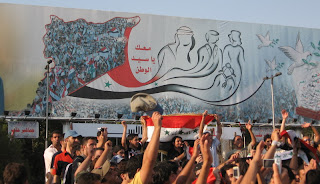
(Iraqi flag wavers beneath a billboard featuring the Syrian borders outlining a collage of Syrian flag wavers)

Proving, I suppose, that all politics are local, the first speeches praised Bashar (I wonder if Bashar had hired these guys to do it -- or maybe it was just his affinity for conservative suits and neckties that generated the outpouring of support). Israel and Hassan Nasrallah quickly followed. Finally they mentioned Iraq, this time in an iteration of "bidam, birooh, nifdayak ya iraq" with blood, with spirit, we will redeem you Iraq and only after that did America come up. At this point conspicuous American with camera and disgustingly sweat stained shirt made his way to the edge of the celebration.

But that didn't keep me from thinking about the larger implications of the day's events. Among them, how many people would die in Baghdad as a result of the team's success. Bombers had targeted the large celebrations after the team's victory in the semifinals and celebratory gunfire took even more lives. Sunday's victory didn't prove to be an exception.

More broadly, I think we are seeing Iraq becoming similar to Palestine as a lightning rod issue sure to elicit sympathy beyond the bounds of the narrow nation-state identity. Though Arab nationalism might be dying, breath still remains, symbolized by the black, green, and red of pan-Arabism still present in most flags. Even in Amman, where the Saudis have traditionally held a monopoly on street celebrations (I spoke with an Iraqi about this and he joked that since they don't work, waving the Saudi flag out the window of German luxury cars while rhythmically honking is all they can do to pass the time), Iraqis filled the streets.

The question for me is whether support of Iraq represents an act of personal-identity projection. That is, what does waving the Iraqi flag mean for a Syrian or a Jordanian? Does she or he view it as an act of solidarity with an embattled nation? An act of resistance against an occupying hegemon? Requiem for a powerful Sunni Arab state? How does this differ for an Iraqi Sunni or Shi'i? These acts of national imagination all rely on particular personal resonance.

Much is made of the unifying power of the football team's run to the championship. The archetypal image of this has been the fluttering Iraqi flag, symbolizing the unity of Kurds, Chaldeans, Turkomen, Sunni, and Shi'a. But if waving the flag represents something completely different for different groups, does the notion of a unified state hold?

I don't know. I suppose it is inevitable that different groups will understand ideas and the symbols that represent them in different ways.

But the most important point here is security, again underscored by the vehicle bans put in place in the capital before the final as well as the Captain Younes Mahmoud's concerns about security in Baghdad.

Away from the solidarity expressed by the regional celebrations, it seems the Asia Cup has provided Iraqis with a brief, if joyous, distraction from everyday life. But the point is that the currents and themes displayed within these celebrations - regional support of the Iraqi "idea," the prevalence of identity in expressions of national belonging - will remain absolutely essential components of the political and the human aspects of life in Iraq and within the region.

Sunday, July 22, 2007

There's symbolism here somewhere

sam

Iraq beat Vietnam yesterday. No, not over which will be the more frequently used foreign policy caveat over for the next fifty years. I think that's already been decided. Prepare for "Iraq Syndrome" to become the darling phrase of punditry, friends.

No, the victory of Iraq over Vietnam was in football and it vaulted Iraq's side into the semi-finals of the Asia Cup, prompting widespread jubilation in the streets of Baghdad.

I watched the bedlam from my neighborhood barber shop - dare I say saloon? - where occasionally I get my hair butchered and, more frequently, I shoot the bull with the neighborhood guys.

A fan circulated fresh air in the room as Muhammad, my Iraqi friend and sometime barber, and I watched the wild celebration. There was plenty of dancing, many Iraqi flags, a few bare chested young men, and even a few a guns. Most seemed to be in the hands of the Iraqi police, though at one point a television reporter armed who, armed with a microphone, had been going rolled-down-car-window to rolled-down-car-window conducting interviews (which, even in such a delirious situation, unfailingly began with "salaam 'aleikum" and "wa 'aleikum asalaam") dove out of the picture as a joyous man pulled a gun from his glove compartment and fired a few rounds into the air.


It seems that more than a few Iraqis endeavored to test gravity last night and, sadly, the intrepid scientists proved Newton's theory right again, with at least two deaths stemming from bullets being fired into the air and, in turn, coming back down.

But this post isn't some attempt to argue that a milennium of authoritarianism has poisoned Iraqi culture to the point that America is not at fault for the problems of the Iraq War. That would, of course, be a topic for Mr. Friedman.

And besides, it would be foolish to act like Americans don't like to shoot their guns up in the air, or other places, every so often either. Rather, this is about unity, even if only for a fleeting moment.

First of all, the unity of humanity. The streets of Baghdad seemed a little like Franklin Street - except without the tree climbing, fire-jumping, or "f*** J.J. Reddick" chants (I thought that one was universal).

But more apparent was the the unity - perhaps transient - of the Iraqi people. In a discourse increasingly dominated by sectarian appelations of Sunni, Shi'a, or Kurd, the resounding phrase of nearly every interview was "al-sha'ab al-'araqee," the Iraqi people. Another interviewee referred to the celebration's demonstration that Iraqis represented fundamentally "al-usra al-waheeda," a united family. Muhammad added that the celebrations were occurring in a mixed portion of Baghdad.


The green, black, and red of the Iraqi flag was everywhere, waved as a banner and worn as capes or cloaks.

Young men made up most of the revelers, though a number of giddy muhajibat participated as well as what looked like a few worried, arms-crossed-across-chests mothers.

As they transitioned to a montage of national team highlights interspersed - like any good nationalist material - with idyllic video of mountains and forests (and if you think Americans are innocent of this, perhaps "from the mountains..." refreshes your memory) they showed a nifty goal. Afterward, the goal scorer lifted up his jersey (in what, after careful consideration, probably wasn't homage to Brandi Chastain), revealing an undershirt bearing the message of "karama lena," dignity for us.

I'm not sure what this all adds up to. I think sometimes people can go too far in their analyses of sport and world events, treating the relationship as a novelty when sport, as a part of the world and life, sometimes does correspond and, indeed, should correspond with current events issues.

But as I watched the continued footage of the celebrations, of people acting in a, well, undignified manner (I think I have authority to say this as someone who may or may not have acted in an undignified manner on Franklin Street), two things struck me.

One, I suppose an element of human dignity is having the freedom to act undignified.

And two, amidst this brief respite from the horrors of occupation, civil war, staticide, or whatever you want to call it, one of the common sayings of the celebrants, the offhand addition to nearly any prediction or hope whether for a peaceful future or simply an Iraqi victory over South Korea in the semis : "in sha allah," god willing.

Monday, June 4, 2007

why are we here?

sam

A lot of people ask me why I’m interested in the Middle East. Some combination of cultural-linguistic fascination and current events, I suppose. I sometimes try to interrogate myself as well, in order to facilitate more articulate answers. Unfortunately, conversations with my ego about the Middle East usually go something like this:

Id: Why am I studying the Middle East? What brings me to this far away region? Did an opthamologist really secure 97% of the vote in the recent Syrian presidential election? Who killed ‘Ali? Why did I choose a language with glottal stops?

Superego: Is that cherry shisha I smell?

Given the depth of my internal dialogue, you can imagine the trouble I have in more formal settings. When I visit the Middle East or, more frequently, apply for schemes that will allow me to visit the Middle East, I’m forced to grapple with this. Once on a boat in the Bosphorous a Syrian man asked me this same devilish question and I (do many things say naïve better than fosha?) answered, “Ureed an afham al-sharq al-awsat,” which, for you non-scribbly speakers out there, means “I want to understand the Middle East,” in the most pretentious formal Arabic possible. The man laughed and said pointedly in English, “I’ve lived in the Middle East all my life and still don’t understand it.”

As for my various applications, I usually dress up an Edward Said quote, expressing my desire to promote cross-cultural understanding in the name of moving past the essentialized caricatures that justify military aggression. It’s sort of like that line from Talladega Nights about baby Jesus – you know, “I like to picture baby Jesus in a tuxedo t-shirt because it says I wanna be formal but I'm here to party” – except in this case the Said quote says I’m formal and the opposition to military aggression means I’m a hippie – which pretty much means I’m ready to party.

But seriously, I’d like to think – in my own little Ivory Tower way - that I’m somehow battling hegemonic and neo-colonial discourses of power through my education. Who knows, though? In the midst of intellectual theorizing and, well, not-so intellectual theorizing (see Ricky Bobby quote above), I sometimes lose sight of what’s at stake.

What I do know is this. The guy sitting next to me on the flight from New York to Amsterdam had a standard issue pixilated desert camo back pack with his last name printed on it beneath his seat. Before the flight started he flipped up his phone, speaking in rapid Spanish to his mother. Once we lifted off, he pulled out his PSP, playing what appeared to be Space Invaders for the duration of the flight. Squinting behind his glasses and clad in an Old Navy polo shirt, he might have been younger than me. He spoke with a man across the aisle about his imminent deployment. “I don’t see us getting out for the next five years at least,” the man across the aisle said, in the type of voice that’s usually followed by a low whistle. “Well I’m locked in for the next 5 years. That means at least three tours left,” the Space Invader killer said.

I bore this in mind during my first few days in Amman, a city no stranger to the scars of war either, with an influx of between 400,000 (the word on the street) and 750,000 (government estimated) Iraqi refugees prompting some Jordanians to refer to upscale ‘Abdoun by the name of ‘Adhamiya, a Sunni neighborhood of Baghdad. And, of course, these are the lucky ones. They join over a million refugees to the north in Syria as those who have temporarily escaped a maelstrom that has killed upwards of 650,000, if you listen to academics.

Now, this isn’t about setting up a binary of suffering or some calculus of misery. After all, we all lose in situations of human suffering. And this is the point, I suppose: that no one is winning here, nor will anyone ever win. Not the bespectacled GI rolling the dice for his remaining tours of duty, not the Iraqi refugees forced to desperate measures.

I’m still trying to comprehend the enormity of the situation. And I’m struggling. And I don’t know if a “better” (whatever that means) or a larger cadre of Middle East specialists could have overcome the quixotic idealism of the neo-conservative movement, the lockstep jingoism of the American media, or the climate of fear among the American public. Colossal efforts by peace groups and rational thinkers came up short. So I don’t know.

But maybe we can keep this in mind as we commence our journeys of learning. It can give us pause, it can give us perspective, and it can give us purpose. Or maybe just a new line for applications.