I wrote earlier about Iraq's victory in the quarterfinals of the Asia Cup and since then the side's success has continued.
As a result, last Sunday sweat dripped down my nose and I looked forward to the oscillating fan's next turn to my side of the room in a packed Aleppo cafe. The championship grudge match between Iraq and Saudi was about to begin.
If the crowd's loyalties were ever in doubt, the first few runs up the pitch removed it. A man in the front row uttered a guttural "helwa," literally meaning sweet, every time the Iraqis made an auspicious move. The rest of the cafe followed his lead, exhorting the Iraqis to pass the ball more precisely, run faster, and reach out their arms farther. The instructions provided to the Saudis mostly contained a message of, as Woody Allen once said, "'be fruitful and multiply' but not in those words."
There was a certain electricity in the room, even when the actual electricity briefly went out during the second half. Young men sat arm-in-arm on the edge of their seats and a constant stream of passerby poked their head in the door for score updates, which for a while consisted of "siphr, siphr," 0-0. At least until the Iraqis broke the gridlock in the second half with a header by Younes Mahmoud. Even "helwa" man in the front row was inaudible amidst the roar that marked the score. Traffic in the streets literally stopped.
The final minutes were tense, with the Saudis managing a few stoppage time attempts on goal.
 But as the final whistle sounded, the celebration was on.
 Honking cab drivers conceded the road to revelers as they marched to Aleppo's main square, waving the Iraqi flag and shouting for joy.
 In the marble square Syrians and Iraqi refugees alike continued the celebration, which occurred, naturally, under the watchful eye of Bashar Al-Assad and other Syrian nationalist imagery.
(Bashar is always watching, this time from a lamp post)
Finally the crowd of merrymakers, ringed by a greater crowd of merrymaker-documenters armed with cell phones and cameras, gathered underneath a martyrs statue of some sort. Chants ensued as did political rhetoric, reminding us of the intricate connection between the ritual of sport and the political undercurrents of everyday life.
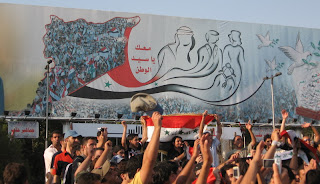
(Iraqi flag wavers beneath a billboard featuring the Syrian borders outlining a collage of Syrian flag wavers)
Proving, I suppose, that all politics are local, the first speeches praised Bashar (I wonder if Bashar had hired these guys to do it -- or maybe it was just his affinity for conservative suits and neckties that generated the outpouring of support). Israel and Hassan Nasrallah quickly followed. Finally they mentioned Iraq, this time in an iteration of "bidam, birooh, nifdayak ya iraq" with blood, with spirit, we will redeem you Iraq and only after that did America come up. At this point conspicuous American with camera and disgustingly sweat stained shirt made his way to the edge of the celebration.
 But that didn't keep me from thinking about the larger implications of the day's events. Among them, how many people would die in Baghdad as a result of the team's success. Bombers had targeted the large celebrations after the team's victory in the semifinals and celebratory gunfire took even more lives. Sunday's victory didn't prove to be an exception.
More broadly, I think we are seeing Iraq becoming similar to Palestine as a lightning rod issue sure to elicit sympathy beyond the bounds of the narrow nation-state identity. Though Arab nationalism might be dying, breath still remains, symbolized by the black, green, and red of pan-Arabism still present in most flags. Even in Amman, where the Saudis have traditionally held a monopoly on street celebrations (I spoke with an Iraqi about this and he joked that since they don't work, waving the Saudi flag out the window of German luxury cars while rhythmically honking is all they can do to pass the time), Iraqis filled the streets.
The question for me is whether support of Iraq represents an act of personal-identity projection. That is, what does waving the Iraqi flag mean for a Syrian or a Jordanian? Does she or he view it as an act of solidarity with an embattled nation? An act of resistance against an occupying hegemon? Requiem for a powerful Sunni Arab state? How does this differ for an Iraqi Sunni or Shi'i? These acts of national imagination all rely on particular personal resonance.
Much is made of the unifying power of the football team's run to the championship. The archetypal image of this has been the fluttering Iraqi flag, symbolizing the unity of Kurds, Chaldeans, Turkomen, Sunni, and Shi'a. But if waving the flag represents something completely different for different groups, does the notion of a unified state hold?
I don't know. I suppose it is inevitable that different groups will understand ideas and the symbols that represent them in different ways.
But the most important point here is security, again underscored by the vehicle bans put in place in the capital before the final as well as the Captain Younes Mahmoud's concerns about security in Baghdad.
Away from the solidarity expressed by the regional celebrations, it seems the Asia Cup has provided Iraqis with a brief, if joyous, distraction from everyday life. But the point is that the currents and themes displayed within these celebrations - regional support of the Iraqi "idea," the prevalence of identity in expressions of national belonging - will remain absolutely essential components of the political and the human aspects of life in Iraq and within the region.


