maryam
*This originally started as a response to Mariam's post below but when i reached a page I decided that I should continue as a post even though I'm not in the Middle East at the present moment*
Mariam I read your post after a very long day of RA (resident advisor) training here in Chapel Hill. I'm tired from only four hours of sleep but with loads of still unfinished work on how to make sure my residents feel a sense of community.
and I'm crying.
It isn't sadness or even joy. Neither frustration nor anger.
It is catharsis.
Out of a staff of around 215 students who are resident advisers, only 4 are Muslim. This number itself seems large to me. But out of these 4 Muslims (all of them are my friends) I am the only one that is colorfully visibly Muslim when looking down at the packed auditorium. Those who know me know it helps that I'm also very loud and opinionated. :)
I sit in that auditorium happy about my hiring. I feel like a breakthrough has been made (though I don't know how accurate that is) for Muslim activism on Campus, or more bluntly, in regular life.
Everyday though I tire more and more from my battle to prove myself. All because of my hijab.
I feel the need to prove that I am not a stereotypical hijab wearing woman. I feel the need to completely break that stereotype. I am no longer only Maryam. I am now The Muslim Woman.
I am loud to prove that we are not quiet.
I am a leader to prove that we are not subservient.
I am smart to prove that we are not uneducated.
I am wise to prove that we are not ignorant.
And while I am proud that I can prove these things to the world, it is not why I wore the scarf.
I started wearing a scarf when I was 8 and by the time I was 10, I was abiding by hijab. It may seem extreme I know but it was completely by choice. My dad even tried to talk me out of it.
See my childhood was not ideal. It was hard. It was hurtful. It was lonely. It was sad. But through that, the innocence of my childhood shined. Accepting pain and hurt I connected to joy and happiness through God. He was the bigger picture. He was the one who would prove to me in the end that my suffering would not be in vain. He loved me, this caring God, loved me more than I could imagine all the people in my life put together. In my child's mind, the hijab felt like a big, warm, and loving hug from God. He felt like a father to me. A second parent.
So I would do anything for the only love I felt I had. To me it was worth the deepest sacrifices.
But all I had to do was abide by hijab. A partition.
That’s it? I thought. All this love from God and all I have to do is abide by a few simple rules?
You see, my upbringing made me realize from a very early age the scarcity but extreme importance of love.
And I accepted the hijab with a full, open, loving heart.
From that moment as a child to this very day my philosophy in life has always been one of self-responsibility.
It is not what life brings to you, but what you bring to life.
Each and every day I continue in this quest to discover what I can bring to life.
And if through the hijab I can break down of stereotypes to these 215 Resident Advisers this week then maybe I will have brought something to life.
But I need to remember why I first wore it.
Remember the eternal love that I can never lose.
Remember my gratefulness for this love.
Remember God.
Thursday, August 9, 2007


Wednesday, August 8, 2007
In the Name of Religion
Marium
The Hijab has always been a symbol of religion for me. I admire my friends who wear it and wish that I had the determination to wear it as they do.
I have never felt the "need" to wear it. I believe that I can be modest without it. I believe that religion is inward. And outward..but a lot more inward for me.
When entering a mosque, tombs of Prophets and holy places in Islam, one is required to wear a scarf on one's head as it signifies respect and modesty.
And in the House of God and the resting places of Prophets, I believe, as others do, that the hijab is a necessity.
Now, I'm sure there are some who agree with my opinion on the hijab and some who don't.
But this is not a blog about the hijab or its place in Islam.
Its about the hijab and its place in my life.
And in Israel.
It was Sarah and I that got to taste the difference that religion can make in one's life in Israel. Especially in a place like Hebron.
Hebron is the final resting place of Abraham or Ibrahim and his wife Sarah, Isaac and Rebecca and Joseph.
Sarah, Sam and I decided to visit their tomb after we spent the day in Ramallah.
We got to Hebron at 6 p.m. and the tomb was closed to everyone except Muslims and Jews.
After convincing the guard at the gate for the Muslim side of the tomb of my "Muslim-ness" I was allowed into the Muslim side.
I walked up to the door leading to the tomb and was stopped by two young Israeli guards. I fixed my green hijab on my head and stared at them for a second.
“Where are you from?” they asked.
Pakistan.
Without a word I was let into the tomb.
It wasn't peaceful in there.
I didn't feel peace in resting place of Abraham, the father of Judaism and the Prophet that built the Ka'aba in Mecca, the holiest place in Islam.
There was an eerie kind of solitude. I peered into the tomb of Sarah and said a prayer. Walking towards the grave of Abraham, I was stopped by a man who took it upon himself to explain to me who and where each Prophet was.
He pointed to a closed door and told me that the grave of Joseph lay behind it.
“Is it not open to Muslims?” I asked, since Joseph is an important Prophet in Islam as well.
No, he said. It was part of the Jewish side of the tomb. There was a time when it was open. When Muslims and Jews mingled and prayed separately but in unison. That was before a man from the Jewish side came to the Muslim side and killed 29 Muslims.
While they were praying.
Ask a Muslim: Who is Abraham?
He is a Muslim. Obviously
Ask a Jew: Who is Abraham?
He is a Jew. Obviously
It wasn't that obvious in the tomb.
I reached up and grabbed the railings of the window that looked into the grave of Abraham. It is a large oval and rectangular shaped coffin with a green, rich cloth covering it.
It was sprinkled with words in Arabic. I read the name of Muhammad and the verses from the Quran.
I said a prayer and looked up to see my friend Sarah's face peering into the room from the other side. I yelled her name.
She didn't hear me.
I yelled out to her again.
And our eyes met.
and I felt the divide.
There stood one of my favorite people in the world. And I couldn't share this moment with her.
We silently looked at each other.
The Muslim and the Jew with a Prophet in the middle.
Is he mine? Or is he hers?
Does it even matter?
I walked out of the Muslim side to meet Sarah and Sam. I didn't take off my hijab as I walked down to the Palestinian shops where Sarah and Sam stood.
We met a Palestinian man, Jamal who said he would show us a birds eye view of Hebron from the roof of his apartment building. We agreed to go with him and as we walked towards his house, Sarah and I went on the main road.
Jamal and Sam walked off to the side road which was cut off by road blocks.
"She's Muslim, she's Muslim, she's Muslim," said an Israeli soldier to another as he poked him with the butt of his gun.
"Yes I am," I said.
"You can't go in there," he said pointing to the Jewish part of town.
Why not, I asked.
You're not Jewish.
Okay but I'm American.
Doesn't matter. You're not Jewish.
There was a fork in the road. I stood in the middle of it as these two guards told me where I could go and where I couldn't.
One side led to the Jewish part of town. One to the Muslim. and all that separated them was a couple of meters and two guards.
Sarah was allowed into the Muslim side but I was not allowed into the Jewish side. We walked over to the Muslim side.
After talking with our Palestinian friend, we headed back to the streets and to a bus stop. My hijab was still glued onto my head.
Two buses went by and didn't stop.
Our Palestinian friend didn't know why.
There was a group of soldiers that stood across from us, from what seemed to be a checkpoint into the Muslim side of town.
We saw boys, old men, women enter the checkpoint and stared as they were searched.
The first bus went by. And then another.
I wondered: Is this because of my hijab?
We asked Jamal and he said it might be.
I refused to take it off.
No way.
The hijab isn't and wasn't a part of my identity. So why did I feel the need to wear it here? I refused to take it off. And I don't exactly know why. All I know is that I refused to be discriminated against based on my religion.
No.
It wasn't right and I wasn't going to give in.
I was not going to take the hijab off.
We waited and soon a group of 4 to 5 Israeli soldiers walked towards us.
I held my head high. My head covered with a green hijab.
I didn't smile.
But they did.
What's the matter, they asked. We told them we were trying to get a bus but it wouldn't stop.
They offered to stop one for us.
And they did. As soon as a bus went by, they stopped it and said something to the driver in Hebrew. We got on the bus and were on our way back to Jerusalem.
I'm not going to talk about the Israeli bus ride or the Jewish settlements we passed by.
The little green towns, people walking dogs, old women sitting on benches and children playing in parks.
I won't talk about the big train/bus station we were dropped off at or the woman who stared at me for at least half an hour on the bus.
This post is about identity as most of my posts are.
It's hard to deal with, the problem with identity and where it fits into our lives. And it gets harder everyday.
It bites at me as I leave the mosque, hide in a dark alley and take off my hijab.
It awakens when someone asks me what religion I am, what nationality.
Wearing a hijab is proclaiming that your identity is what you look like. You look Muslim, therefore it seems to be a big part of who you state you are.
Without a hijab, you merge into a crowd, faceless and unimportant.
You do not wear your identity.
And that in itself is a blessing. Especially in a country like Israel that is divided by nationalist and religious lines.
But in Hebron, it is not about nationality. It is just about religion.
I can now understand why some women would decide to wear the hijab for political reasons. It is a theory that has floated around the world as more women started wearing the hijab after 9/11. Some analysts have argued that more women started wearing the hijab after 9/11 to support their religion as they felt it was a religion that was under attack.
As Amin Maalouf explains in his book, “In the Name of Identity,” we as humans tend to cling to the identity that we feel is under attack.
Islam was/is under “attack,” so wearing the hijab signifies support for it.
I understand that.
Because if you are going to be prejudiced based on my religion. So be it.
I wear my religion and I wear it proud.
As I write this, I am sitting in an Israeli coffee shop in the New city in West Jerusalem.
I came here right after I went for the afternoon prayer to the mosque. I left the mosque with my hijab on my head and entered the coffee shop with my hair in a bun and my hijab in my bag.
I've heard stories about girls not being let into Israeli shops because they wear the hijab.
And I wanted to try and see whether the same thing would happen to me.
Would they stop me at the door if I was wearing a hijab?
Would I take it off if they told me I couldn't go in?
Or would they surprise me with a smile. And help me get to where I have to go?
Israel is a country of contradictions. A country where you expect interrogation and are given a smile in return.
Its a place where I see guns, a separation wall, inequality and discrimination. But it is also a place where an Israeli rabbi says to me that God is one; Muslims and Jews are one.
If we are one, why do we need walls?
I look around this new city and see children in baby carriages, soldiers with guns talking on cell phones, iced lattes and Mercedes'.
Life doesn't seem so bad. Until you remember that the coffee shop you are sitting in was probably once the home of a Palestinian. A Palestinian who probably still has the keys to his house. A house that no longer exists.
In its place is a coffee shop where I sit sipping an iced latte, my head uncovered and no one questions my right to be here.
Friday, August 3, 2007
An idea for Bashar's next poster
sam
Friends,
In a misguided attempt to promote readership on the blog, I promised to include a Will Ferrell reference in each of my posts.
I've failed miserably. But here is my attempt to make amends.
Does anyone else notice a likeness between "I think the camera caught him by surprise on this one" King Abdullah and a certain American actor well known for running around in his underwear? Well, if you never noticed it before, all you have to do is turn around (or just scroll down).
 "I think the camera caught him by surprise on this one" Will Ferrell from Old School, care of the incomparable Joey Dolbee.

I've been bashing Syrian President Bashar Al-Assad for the lack of variety in his nationalist iconography. But I think it's safe to say that he could redeem himself with one shot like this.
If not, I can only think of one other image that could make up for all of his seriousness and Jean Claude Van Damme grimmaces. More cowbell and a giggling Jimmy Fallon figure prominently in it.
Pick a Border, Pick an Identity.
Marium
It was 4 AM when we got to the Syrian border. I was with Mike Mallah, his sister, cousin and his friend. Four Jordanians and a Pakistani.
American.
I exited Jordan with my American passport and nervously entered the Syrian border security with my American passport carefully tucked away in my wallet, with my green Pakistani passport in my hand.
"Pakistani?" the tall syrian asked.
"Yes."
It was a reunion. A happy one. Syrians love Pakistanis apparently. They especially love the ones that speak broken Arabic.
"How long for a visa?" I asked.
The Syrian smiled and waved his hand.
Five minutes.
I glanced over at my Jordanian friends who were still in line.
Could it be? Could I really enter Syria without letting them know that I also had a blue passport?
Five syrian soldiers crowded around the window. A thin glass window seperated me and a group of Syrians. I felt warm, welcome and if there had been no window, I would have even expected a hug.
Yalla Ya Pakistan, they exclaimed.
"Where is your exit stamp from Jordan?"
Oh no. My heart dropped. I smiled. Gingerly taking out my American passport, I handed it to the Syrian and said, "Here."
Silence.
He took my Pakistani passport and threw it at the window.
"You are American."
It wasn't a question.
No. I'm Pakistani. I'm not American. I dont live in America. My family lives in Pakistan. We might be going for Umrah (the smaller Hajj) in Ramadan to Saudi Arabia. I am Muslim. I am Pakistani.
"You are American."
"How long for a visa?" The American Pakistani asked.
"We dont know. Possibly 6 hours. 7 hours. 8. A day. Two days. Damascus has to give us clearance."
"How long for a visa?" the Pakistani had asked 5 minutes before.
"Five minutes."
I decided to wait for the visa. I watched as my American passport was put aside, forgotten and my Pakistani was given back to me.
I waited for 2 hours. I got up and went to the window that said "foreigners" and asked for my passport. I decided to go back to Amman. It wasn't worth it.
"Wait," the sympathetic Syrian said, "just wait a little while longer."
Im Pakistani, I told him. Im American, I told him. Im not shit, I told him.
Give me back my passport.
The cab driver who was driving me back to Amman asked me where I was from.
I am American, I replied.
Tomorrow I am going to Israel. I've been there before. Last year I was at the border for a very, very long time.
"You're Pakistani?" the Israelis asked.
"Im American," I said, "I'm not Pakistani."
I live in America. My family lives in America. I've come to see Jerusalem. I know very few Pakistanis. I dont live in Pakistan. I am American.
"How long will it take?" I asked the Israelis.
"We dont know. 6 hours, 7 hours, a day. We dont know."
But I'm American.
"You were born in a terrorist country." they replied.
Im American. Not Pakistani.
Im Pakistani. Not American.
In this world I can't be both.
Pick one.
Or just lie.
Thursday, August 2, 2007
(about more than football)
sam
I wrote earlier about Iraq's victory in the quarterfinals of the Asia Cup and since then the side's success has continued.
As a result, last Sunday sweat dripped down my nose and I looked forward to the oscillating fan's next turn to my side of the room in a packed Aleppo cafe. The championship grudge match between Iraq and Saudi was about to begin.
If the crowd's loyalties were ever in doubt, the first few runs up the pitch removed it. A man in the front row uttered a guttural "helwa," literally meaning sweet, every time the Iraqis made an auspicious move. The rest of the cafe followed his lead, exhorting the Iraqis to pass the ball more precisely, run faster, and reach out their arms farther. The instructions provided to the Saudis mostly contained a message of, as Woody Allen once said, "'be fruitful and multiply' but not in those words."
There was a certain electricity in the room, even when the actual electricity briefly went out during the second half. Young men sat arm-in-arm on the edge of their seats and a constant stream of passerby poked their head in the door for score updates, which for a while consisted of "siphr, siphr," 0-0. At least until the Iraqis broke the gridlock in the second half with a header by Younes Mahmoud. Even "helwa" man in the front row was inaudible amidst the roar that marked the score. Traffic in the streets literally stopped.
The final minutes were tense, with the Saudis managing a few stoppage time attempts on goal.
 But as the final whistle sounded, the celebration was on.
 Honking cab drivers conceded the road to revelers as they marched to Aleppo's main square, waving the Iraqi flag and shouting for joy.
 In the marble square Syrians and Iraqi refugees alike continued the celebration, which occurred, naturally, under the watchful eye of Bashar Al-Assad and other Syrian nationalist imagery.

(Bashar is always watching, this time from a lamp post)
Finally the crowd of merrymakers, ringed by a greater crowd of merrymaker-documenters armed with cell phones and cameras, gathered underneath a martyrs statue of some sort. Chants ensued as did political rhetoric, reminding us of the intricate connection between the ritual of sport and the political undercurrents of everyday life.
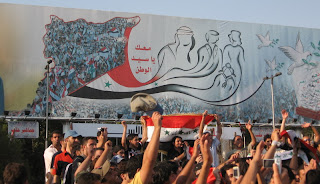
(Iraqi flag wavers beneath a billboard featuring the Syrian borders outlining a collage of Syrian flag wavers)
Proving, I suppose, that all politics are local, the first speeches praised Bashar (I wonder if Bashar had hired these guys to do it -- or maybe it was just his affinity for conservative suits and neckties that generated the outpouring of support). Israel and Hassan Nasrallah quickly followed. Finally they mentioned Iraq, this time in an iteration of "bidam, birooh, nifdayak ya iraq" with blood, with spirit, we will redeem you Iraq and only after that did America come up. At this point conspicuous American with camera and disgustingly sweat stained shirt made his way to the edge of the celebration.

 But that didn't keep me from thinking about the larger implications of the day's events. Among them, how many people would die in Baghdad as a result of the team's success. Bombers had targeted the large celebrations after the team's victory in the semifinals and celebratory gunfire took even more lives. Sunday's victory didn't prove to be an exception.
More broadly, I think we are seeing Iraq becoming similar to Palestine as a lightning rod issue sure to elicit sympathy beyond the bounds of the narrow nation-state identity. Though Arab nationalism might be dying, breath still remains, symbolized by the black, green, and red of pan-Arabism still present in most flags. Even in Amman, where the Saudis have traditionally held a monopoly on street celebrations (I spoke with an Iraqi about this and he joked that since they don't work, waving the Saudi flag out the window of German luxury cars while rhythmically honking is all they can do to pass the time), Iraqis filled the streets.
The question for me is whether support of Iraq represents an act of personal-identity projection. That is, what does waving the Iraqi flag mean for a Syrian or a Jordanian? Does she or he view it as an act of solidarity with an embattled nation? An act of resistance against an occupying hegemon? Requiem for a powerful Sunni Arab state? How does this differ for an Iraqi Sunni or Shi'i? These acts of national imagination all rely on particular personal resonance.
Much is made of the unifying power of the football team's run to the championship. The archetypal image of this has been the fluttering Iraqi flag, symbolizing the unity of Kurds, Chaldeans, Turkomen, Sunni, and Shi'a. But if waving the flag represents something completely different for different groups, does the notion of a unified state hold?
I don't know. I suppose it is inevitable that different groups will understand ideas and the symbols that represent them in different ways.
But the most important point here is security, again underscored by the vehicle bans put in place in the capital before the final as well as the Captain Younes Mahmoud's concerns about security in Baghdad.
Away from the solidarity expressed by the regional celebrations, it seems the Asia Cup has provided Iraqis with a brief, if joyous, distraction from everyday life. But the point is that the currents and themes displayed within these celebrations - regional support of the Iraqi "idea," the prevalence of identity in expressions of national belonging - will remain absolutely essential components of the political and the human aspects of life in Iraq and within the region.
it's cold outside
sam
Friends,
You thought you were rid of me. But I'm back with a rant for your pleasure.
Many things have changed since my last post. For one, I’ve single handedly depleted Syria of its supplies of cherry kebabs and smoothies. That's not true. But I did my darnedest.
More ominously and certainly less deliciously, the Bush administration is, according to Columbia academic Gary Sick, engaging in martial arts with Iran, effectively signalling the start of a new Cold War. With a $ 20 billion (that’s right, with a b) arms deal, the United States has thrown its support behind (or, more accurately, increased it support of) conservative Arab regimes and Israel against the Iranian government.
The geo-political calculations behind this strategic decision are many, but one way to examine it is in the context of Mr. Bush’s foreign policy experts. Heralded as the Vulcans when Bush entered office, these men and women had cut their teeth in the waning days of the Cold War, when, depending on the source, America defeated the "Evil Empire" or a weak state-without-a-nation completed its slow motion collapse. Creating the familiar paradigm of moral clarity embodied by the former scenario seems to loom large in the thinking of Bush's foreign policy team. Remember the Long War?
But the differing nature of Al-Qaeda’s threat - as a non-state entity - threw a wrench into these formulations and they pulled a Gatsby (“Can’t repeat the past? Why of course you can.”), seeking a return to wars with discrete nation states. See Iraq and, as it seems now, Iran, where the threat of a country with an economy smaller than that of the great state of Illinois seems to warrant dumping $20 billion worth (again, with a b) of arms into the region.
Where will these arms be in ten years? Who will they be pointed at? Which mothers, fathers, sons, or daughters will be killed by them?
Who is complicit?
If they’d read to the end of Gatsby (you and i both know that Mr. Bush never attended his American lit course at Yale, but I expected more from Ms. Rice) and learned about “what preyed upon him, what foul dust floated in his wake,” they may have known better.
Or they could have just listened to Lonnie Rashid Lynn, Jr., aka one of Chicago’s finest MCs, aka Common, aka Common Sense, who would have told them, “It ain’t ’94 (’84) Joe, we can’t go back.”
Or they could have consulted the millions of human beings (largely in the third world) for whom the Cold War wasn’t so mercifully cold. But I suppose they're not around to say anything.
So it's back to business as usual, leaving some to wonder why we fight.
Wednesday, August 1, 2007
Are you listening MPAC?
Matt
Hello Good People,
I had a striking, nay stunning, realization the other day which undoubtedly merits sharing with you, the countless loyal readers of this blog. Adel, one of my Arabic teachers here in Cairo, recently had a beautiful baby boy (ma sha Allah!) by the name of Jaleel. When he mentioned the name, I didn't think much of it then, but it was impossible to shake the feeling that I already knew someone by that name.
Now by and large the vast majority of men in Cairo are named Muhammad or Ahmad which makes the phonebook in my cell phone a nightmare. The other day when I sat down for chess, there were 4 Muhammad's, 1 Ahmad, and a Rafeeq. Needless to say, last names are a must in this city. But I digress.
For whatever reason I kept mulling over the name Jaleel, until it hit me. There is only one other person in the world I know with that name: Steven Q. Urkel, star of the 1990's sitcom Family Matters and icon for all those kids who grew up watching TGIF on ABC, was played by Jaleel White.
A follow-up question came to mind. Was Steve Urkel Muslim? A little bit of legitimate research later (read Wikipedia) and the answer turned out to be yes. Who knew?
Perhaps I should prepare a letter to the Muslim Public Affairs Council giving my highest recommendation that Jaleel White become their new spokesman. Such a figure so ingrained in the television consciousness of America is sure to make inroads in inter-religious dialogue. Brilliant!
Thanks for reading.
Subscribe to:
Posts (Atom)